
For years, Shopify has been one of the most trusted names in e-commerce.
Millions of online stores, startups, entrepreneurs, and global brands rely on its infrastructure every single day. It has become synonymous with reliability, scalability, and growth. For many business owners, Shopify isn’t just a platform; it is the backbone of their entire operation.
But what happens when that backbone suddenly cracks?
What happens when the platform that powers millions of businesses experiences disruptions, outages, or unexpected failures?
The question is bigger than Shopify itself.
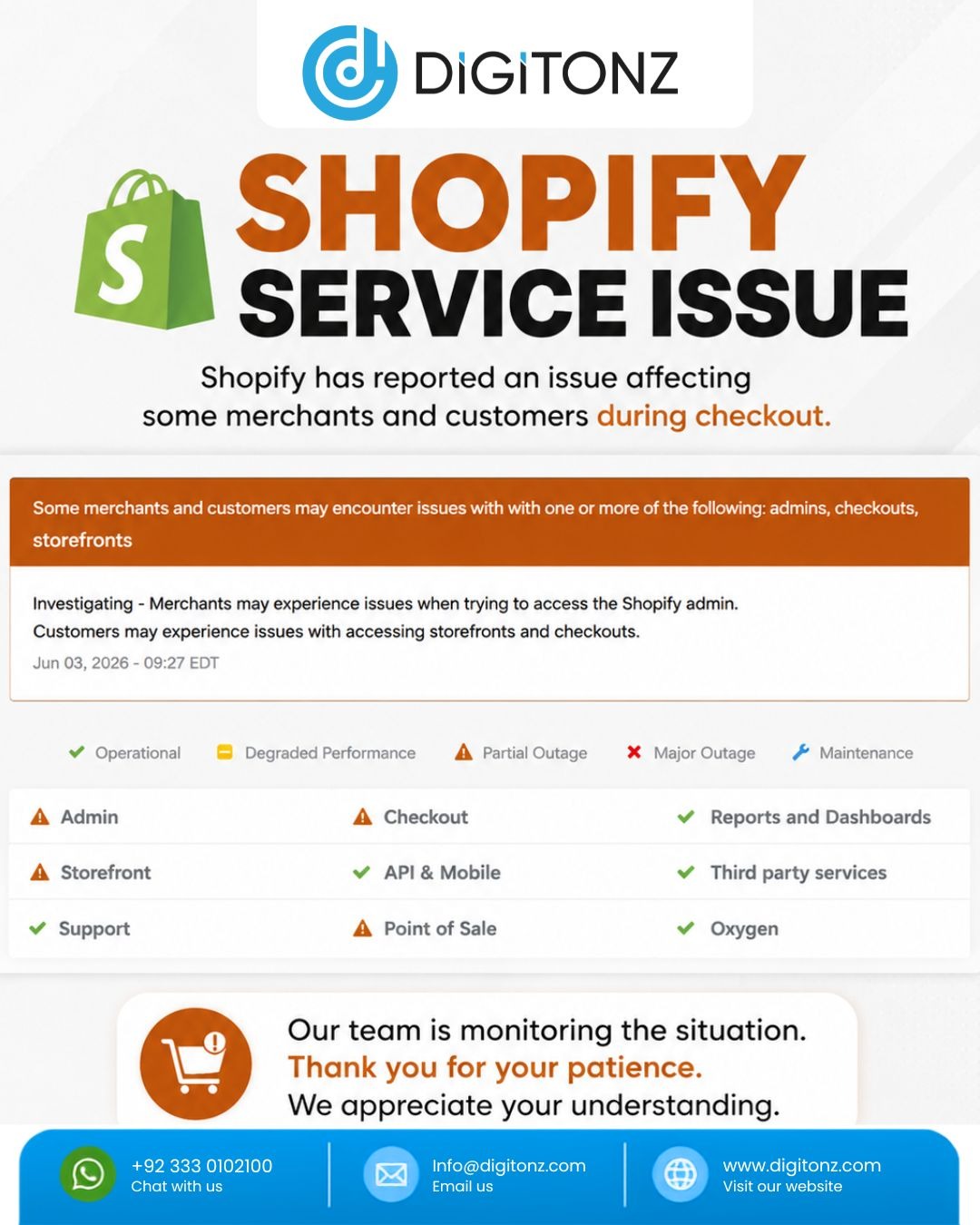
If a giant like Shopify can stumble, what does that say about the future of e-commerce?
The Illusion of Stability in E-Commerce
Modern e-commerce has created a sense of security that many businesses have come to depend on.
With a few clicks, anyone can launch a store, process payments, manage inventory, and sell products worldwide. The technology feels seamless. The systems feel permanent.
Until they don’t.
A temporary outage can instantly bring thousands of stores to a halt. Customers can’t place orders. Marketing campaigns continue spending money while landing pages fail to load. Support teams are overwhelmed. Revenue disappears by the minute.
In a world where every second of downtime has a cost, even a brief disruption can create a ripple effect across an entire business ecosystem.
When a Platform Goes Down, the Impact Is Immediate
Many people assume a website outage is simply a technical inconvenience. In reality, the consequences can be much more serious.
A platform disruption can lead to:
- Lost sales and abandoned transactions
- Interrupted marketing campaigns
- Customer frustration and loss of trust
- Delays in order processing
- Increased pressure on customer support teams
- Damage to a brand’s reputation
For businesses that rely heavily on online sales, even a short period of downtime can translate into significant financial losses.
The Hidden Risk of Platform Dependency
One of the biggest lessons from any major e-commerce outage is the danger of putting all your eggs in one basket.
Many online stores are built entirely around a single platform. Their website, customer data, inventory management, payment processing, and marketing integrations all depend on one ecosystem.
This creates a situation where businesses become vulnerable to factors beyond their control, including:
- Technical failures
- Infrastructure outages
- Policy changes
- Account suspensions
- Security incidents
- Third-party integration issues
The more dependent a business becomes on a single provider, the greater the risk when something goes wrong.
Why the Future of E-Commerce Is Not About Platforms
The future of e-commerce will not be determined by which platform has the most features or the biggest market share. It will be determined by which businesses are best prepared for uncertainty.
Successful brands are increasingly focusing on building assets they truly own, including their customer relationships, email lists, brand identity, and organic search presence.
Rather than relying entirely on a single platform, forward-thinking businesses are investing in diversified growth strategies that allow them to remain operational even when one channel experiences problems.
What Smart Businesses Are Doing Differently
The most resilient e-commerce companies understand that technology is a tool, not a guarantee.
They are:
- Building strong brands instead of depending solely on platforms
- Investing in SEO and organic traffic
- Growing email marketing databases
- Expanding across multiple sales channels
- Maintaining backup systems and contingency plans
- Focusing on customer loyalty and retention
These businesses recognize that long-term success comes from adaptability, not dependence.
A Wake-Up Call for the Industry
Shopify remains one of the most powerful and reliable e-commerce platforms available today. The purpose of discussing outages is not to question their value but to highlight an important reality: no technology company is immune to disruption.
History has shown that even the world’s largest technology providers can experience unexpected challenges. Whether it is a server issue, network failure, security incident, or software bug, problems can occur at any scale.
The real question is not whether another outage will happen.
The real question is whether businesses are prepared when it does.
The Future Belongs to Resilient Businesses
E-commerce is not going anywhere. In fact, online retail is expected to continue growing rapidly over the coming years. The opportunities are enormous, and technology will continue to make entrepreneurship more accessible than ever before.
However, the businesses that thrive will not be those that blindly trust technology to solve every problem. They will be the businesses that prepare for challenges, diversify their operations, and build strong foundations that extend beyond any single platform.
If recent events have taught the industry anything, it is this: platforms can power a business, but they should never become the business itself.
In the future of e-commerce, resilience will matter more than convenience, adaptability will matter more than dependency, and businesses that understand this reality will be the ones that survive and succeed in an increasingly unpredictable digital world.
